
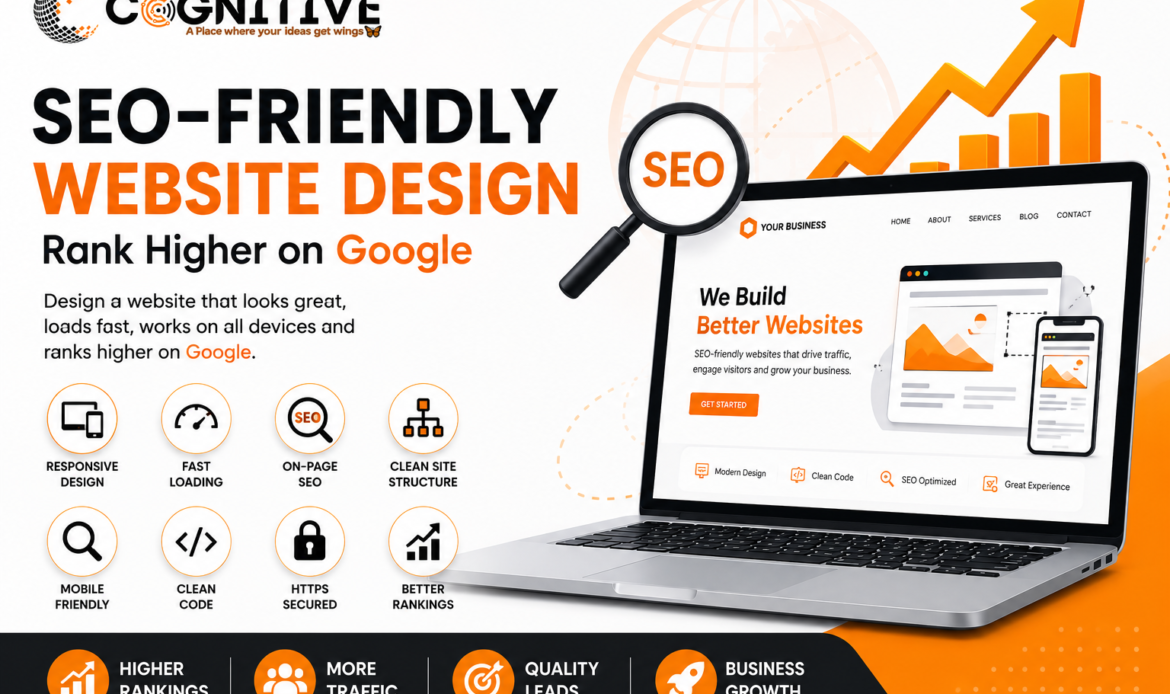
SEO-Friendly Website Design: How to Build a Website That Ranks Higher on Google
A website can look impressive and still fail to generate business.
Beautiful colours, animations and layouts may capture attention, but if Google cannot properly crawl the website, pages load slowly, content does not match what customers search for, or visitors cannot easily find what they need, the website may struggle to generate organic traffic and enquiries.
This is why modern businesses need more than attractive web design. They need SEO-friendly website design.
An SEO-friendly website combines design, development, technical SEO, content strategy, user experience and conversion optimisation to create a website that is easier for search engines to understand and more useful for potential customers.
At Cognitive Tech Soft, we believe SEO should be considered while planning and developing a website—not added only after the website is completed.
In this guide, we’ll explain how to build a website with a stronger foundation for Google rankings, organic traffic, lead generation and emerging AI-powered search experiences.
What Is SEO-Friendly Website Design?
SEO-friendly website design means creating a website that is accessible and understandable to search engines while delivering a useful experience to visitors.
It involves much more than inserting keywords into a page.
An SEO-friendly website should have:
- Clear website architecture
- Fast-loading pages
- Mobile-responsive design
- Crawlable and indexable content
- Search-friendly URLs
- Logical heading structure
- Helpful, original content
- Optimized images
- Strong internal linking
- Correct canonical URLs
- HTTPS security
- Appropriate structured data
- Clear calls to action
- Good overall page experience
Google itself describes SEO as helping search engines understand your content while helping users discover your website and decide whether they should visit it.
Does Website Design Really Affect Google Rankings?
Website design does not work like a single ranking switch where changing a layout automatically moves a page from position 20 to position 1.
Its impact is broader.
Poor website development can create SEO problems such as the following:
Slow loading → Poor user experience
Confusing navigation → Important pages become difficult to discover
Incorrect robots.txt → Search engines may struggle to crawl content
Duplicate URLs → Multiple versions of the same content
Poor mobile design → Frustrated mobile visitors
Weak site architecture → Search engines have less context about page relationships
JavaScript problems → Important content may become harder to process
Therefore, SEO and website development should work together from the beginning.
1. Start With Keyword Research Before Designing the Website
One mistake businesses make is designing the entire website first and thinking about SEO later.
We recommend doing basic keyword and competitor research before finalising the website structure.
Suppose a digital marketing company provides:
- SEO
- Google Ads
- Social media marketing
- Website development
- Local SEO
- Lead generation
Customers are unlikely to search for all these services using one keyword.
They may search for:
Google Ads agency in Hyderabad
Website development company in Hyderabad
Social media marketing agency in Hyderabad
Local SEO services
This search behaviour should influence the website architecture.
Instead of placing every service on one generic page, important services can have dedicated pages with genuinely useful information.
2. Build a Clear SEO-Friendly Website Architecture
Think of your website as a hierarchy.
For example:
Homepage
↳ Digital Marketing Services
↳ SEO Services
↳ Google Ads
↳ Social Media Marketing
↳ Website Design & Development
↳ Local SEO
↳ About Us
↳ Blog
↳ Contact Us
Then build supporting content around your important services.
For example:
Website Design & Development
↳ SEO-Friendly Website Design
↳ WordPress Website Development
↳ E-Commerce Website Development
↳ Website Speed Optimization
↳ Website Redesign
↳ Website Maintenance
This creates logical relationships between pages and makes navigation easier for visitors.
3. Give Important Services Their Own Pages
Trying to rank a homepage for every service is rarely the best content strategy.
If website development is an important service, create a comprehensive website development services page.
If SEO is important, create an SEO services page.
Then support those commercial pages with useful informational content.
For example:
Main Service Page
Website Development Company in Hyderabad
Supporting Articles
- SEO-Friendly Website Design
- Website Speed and SEO
- WordPress Website Design for SEO
- Website Redesign SEO Checklist
- How Website Design Affects Google Rankings
- How to Build a Website for Google and AI Search
This approach helps build deeper topical coverage rather than publishing unrelated articles.
4. Make Mobile Experience a Priority
Your website should work smoothly across smartphones, tablets, laptops and desktops.
A mobile-friendly website should have:
- Readable fonts
- Responsive layouts
- Easy-to-use navigation
- Properly sized buttons
- Optimized images
- Accessible forms
- Visible contact options
- No unnecessary horizontal scrolling
- Reasonable spacing between interactive elements
Don’t simply shrink the desktop version.
Ask:
Can a customer understand what we offer within a few seconds on mobile?
Can they easily call or contact us?
Can they navigate between services without confusion?
Does the page load efficiently on a mobile connection?
Google recommends providing a good page experience across devices as part of its guidance for both traditional and generative AI search experiences.
5. Build for Speed From the Beginning
Website speed problems often start during development.
A page can become unnecessarily heavy because of:
- Huge images
- Excessive animations
- Too many plugins
- Multiple font files
- Unused CSS
- Unnecessary JavaScript
- Heavy page-builder elements
- Third-party tracking scripts
- Poor hosting configuration
Adding another optimisation plugin after development doesn’t always solve the underlying problem.
A better approach is to consider performance while designing.
Practical Website Speed Improvements
Compress images before uploading them.
Use WebP or AVIF where appropriate.
Avoid uploading a 5 MB image when a much smaller optimised version provides the same visible quality.
Use lazy loading appropriately.
Remove plugins and scripts you don’t need.
Use caching.
Optimise CSS and JavaScript carefully.
Choose suitable hosting for your website.
Test important pages after major design changes.
6. Understand Core Web Vitals
Core Web Vitals help measure aspects of real-world page experience.
Three important metrics are the following:
Largest Contentful Paint (LCP)
LCP measures loading performance for the largest visible content element.
Interaction to Next Paint (INP)
INP evaluates responsiveness to user interactions.
Cumulative Layout Shift (CLS)
CLS measures unexpected visual movement while a page is loading.
Don’t optimise these metrics simply to achieve a green score.
The broader goal is to create a website that loads quickly, responds smoothly and remains visually stable.
7. Use Clean and Descriptive URLs
A visitor should be able to get an idea of the page topic from its URL.
For example:
Better:
/seo-services-hyderabad/
/website-development/
/google-ads-services/
Poor structure:
/page?id=72891
/services/page1-new-final/
Avoid unnecessarily changing URLs after pages begin ranking.
If an important URL must change, implement the appropriate redirect rather than simply deleting the old URL.
8. Create Clear Page Titles and Headings
Each important page should have a clear primary topic.
For example:
SEO Title
Website Development Company in Hyderabad | Cognitive Tech Soft
H1
Website Development Company in Hyderabad
Supporting H₂
Our Website Development Services
SEO-Friendly Website Development
Our Web Development Process
Why Choose Cognitive Tech Soft?
Frequently Asked Questions
Headings should organise information for readers rather than simply provide additional places to repeat keywords.
Google specifically recommends well-organised, easy-to-read content with useful headings.
9. Don’t Stuff Keywords Into Your Website
An SEO-friendly website does not need the same keyword repeated in every paragraph.
For example, if your target is the following:
Website Development Company in Hyderabad
You can naturally discuss related concepts such as the following:
- Website development services
- Web design company
- Business website development
- WordPress development
- Responsive website design
- E-commerce development
- SEO-friendly websites
- Website redesign
- Web development services
Google’s systems can understand how pages relate to searches even when every exact keyword variation is not explicitly repeated.
Write naturally first.
Optimise intelligently, second.
10. Create Content That Competitors Cannot Easily Copy
This is particularly important as AI-generated content becomes easier to produce.
If your article simply says the following:
Make your website fast. Make it mobile-friendly. Add keywords. Create backlinks.
Thousands of websites can say exactly the same thing.
Instead, add information based on actual experience.
For example, a web development agency can discuss:
- Common WordPress SEO problems it encounters
- Website migration mistakes it has fixed
- Real page-speed problems discovered during development
- Before-and-after performance improvements
- Website architecture examples
- Screenshots from Search Console
- Examples of successful redesign decisions
- Original checklists used during website launches
Google’s current generative-AI search guidance specifically recommends unique, non-commodity content and first-hand perspectives rather than simply recycling information already available online.
Cognitive Tech Soft Insight
When developing a business website, we recommend finalising the primary services, target locations, important keywords and URL structure before building the navigation.
This reduces the likelihood of having to restructure important URLs after launch.
It also allows SEO requirements to influence the website architecture from the beginning.
11. Make Your Business Information Explicit
Don’t make visitors—or search systems—guess what your company does.
A business website should clearly communicate:
Who you are
What services you provide
Where you provide them
Who you serve
How customers can contact you
For example:
Cognitive Tech Soft is a digital marketing and website development company in Hyderabad providing website development, SEO, Google Ads, social media marketing and digital growth services for businesses.
A clear statement provides immediate context.
Use consistent business information across your:
- Homepage
- About page
- Contact page
- Service pages
- Google Business Profile
- Relevant business listings
12. Optimize Images Properly
Images are important for both design and search visibility.
Google recommends using high-quality images near relevant textual content, and its current AI-search guidance notes that images and video can provide additional opportunities for visibility.
Instead of uploading:
IMG_847283.jpg
consider:
seo-friendly-website-design.jpg
Use descriptive ALT text when it serves an accessibility purpose and accurately describes the image.
Also optimise image dimensions and file size.
An attractive image should not unnecessarily slow down the page.
13. Build Strong Internal Links
Internal linking is one of the most useful elements of website SEO.
Suppose you publish this article:
SEO-Friendly Website Design
Within it, you can naturally link to:
Website Development Services
SEO Services in Hyderabad
Technical SEO Services
Digital Marketing Services
Website Speed Optimization
Your website development service page can also link back to relevant educational articles.
This creates relationships such as the following:
Website Development
↓
SEO-Friendly Website Design
↓
Website Speed & Core Web Vitals
↓
Technical SEO
Google recommends making important content easily discoverable through internal links, including for AI features in Search.
14. Make Sure Google Can Crawl and Index Important Pages
SEO-friendly design also requires technical accessibility.
Check:
- Robots.txt
- XML sitemap
- Canonical tags
- Indexability
- HTTPS
- Redirects
- Broken links
- Duplicate URLs
- HTTP status codes
- Internal links
A page cannot generate much organic visibility if search engines cannot properly access or index it.
After publishing an important page, use Google Search Console to verify that Google can access the intended canonical URL.
15. Maintain One Preferred Website Version
A website may technically be accessible through variations such as the following:
http://example.com
http://www.example.com
Choose one preferred version and configure redirects and canonicalisation consistently.
For example:
This helps prevent unnecessary duplicate URL versions and keeps internal linking consistent.
16. Use Structured Data Where It Makes Sense
Structured data can help search engines understand specific information and can make pages eligible for certain search features.
Depending on the page, relevant structured data may include:
- Organization
- Local Business
- Article
- Breadcrumb
- Product
- Event
- Person
- Video
The structured data should accurately match information visible on the webpage.
However, don’t install dozens of schema types because someone claims they will make ChatGPT or Google AI rank your website.
Google states that there is no special schema markup required for its generative AI search features.
17. Build Trust Into the Website
Visitors need reasons to trust a business before contacting it.
Depending on your business, useful trust elements can include:
- About the company
- Team information
- Real project examples
- Case studies
- Testimonials
- Client reviews
- Contact information
- Business location
- Original images
- Certifications where applicable
- Author information for expert articles
- Clear service descriptions
Google’s people-first content guidance encourages clear sourcing and evidence of the expertise or experience behind content.
For a web development company, a real case study can often provide more value than another generic article about “10 reasons you need a website”.
18. Design Pages to Generate Leads, Not Just Traffic
SEO traffic has limited business value if visitors don’t take action.
Your service pages should answer four questions quickly:
What do you provide?
Make the service clear.
Who is it for?
Explain the types of businesses you help.
Why should someone choose you?
Provide genuine differentiators and evidence.
What should the visitor do next?
Provide a clear CTA.
For example:
Request a Website Consultation
Get a Free Quote
Talk to Our Web Development Team
Call Now
WhatsApp Us
The journey should feel natural:
Google Search → Website → Information → Trust → CTA → Lead
19. How to Design a Website for Google and AI Search
This is becoming increasingly important.
Google has confirmed that its existing SEO fundamentals remain relevant to AI Overviews and AI Mode. Pages need to be indexed and eligible to appear in Search; there is no separate secret optimisation required for these AI features.
For stronger search and AI discoverability, focus on:
Answer Specific Questions Clearly
For example:
What is SEO-friendly website design?
SEO-friendly website design is the process of building a website so users can navigate it easily and search engines can efficiently crawl, understand and index its important content.
Make Entities Clear
Clearly identify:
Company: Cognitive Tech Soft
Service: Website Design & Development
Location: Hyderabad
Related Services: SEO, Google Ads, digital marketing
Create Original Information
Add:
- Your experience
- Your process
- Original examples
- Case studies
- Screenshots
- Comparisons
- Data where available
- Lessons learned from actual projects
Keep Important Information in Text
Don’t put critical information only inside images or animations.
Google specifically recommends keeping important content available in textual form.
20. Don’t Create Separate Content Just for AI Bots
You may see recommendations such as the following:
“Write every paragraph specifically for ChatGPT.”
“Create hundreds of AI question pages.”
“Add special AI schema.”
“Break every article into tiny chunks for AI.”
Be careful with these approaches.
Google’s current guidance says there is no requirement to rewrite content specifically for generative AI search, no ideal page length, no special schema, and no requirement to break content into tiny chunks.
Instead, create genuinely useful pages for your customers.
That’s a more sustainable approach for both traditional and AI-powered search.
21. SEO-Friendly Website Design Checklist
Before launching a new website, check:
✓ Keyword research completed
✓ Competitor research completed
✓ Main services have dedicated pages
✓ Website architecture is logical
✓ URLs are clean
✓ Mobile design works properly
✓ Pages load efficiently
✓ Images are optimized
✓ H1/H2 structure is clear
✓ Titles and meta descriptions are unique
✓ Content answers customer questions
✓ Internal links are added
✓ HTTPS works correctly
✓ Preferred domain is configured
✓ Canonical URLs are correct
✓ XML sitemap is generated
✓ Robots.txt is checked
✓ Important pages are indexable
✓ Redirects work correctly
✓ Structured data is accurate where applicable
✓ Analytics are installed
✓ Search Console is configured
✓ Calls to action work
✓ Forms are tested
✓ Phone and WhatsApp buttons work
✓ Contact details are consistent
Common SEO Web Design Mistakes
Avoid:
- Designing first and thinking about SEO later
- Creating one page for every keyword variation
- Copying competitor content
- Publishing generic AI-generated articles without adding expertise
- Keyword stuffing
- Uploading huge images
- Excessive animations
- Poor mobile navigation
- Changing URLs without redirects
- Incorrect canonical tags
- Blocking important resources or pages
- Thin service pages
- Broken internal links
- Duplicate content
- Making important information available only inside images
Google emphasises unique, useful, people-first content rather than content primarily produced to manipulate search rankings.
SEO-Friendly Website Design vs Traditional Website Design
| Traditional Approach | SEO-Friendly Approach |
|---|---|
| Focus mainly on appearance | Design + SEO + UX |
| SEO considered after launch | SEO planned before development |
| Generic service pages | Search-intent-focused pages |
| Heavy images/animations | Performance-conscious assets |
| Limited internal linking | Strategic internal linking |
| Desktop-first thinking | Responsive experience |
| Traffic not considered | Organic discovery considered |
| Generic content | Helpful, expert-led content |
| Basic contact page | Conversion-focused journey |
| Search and design separate | SEO integrated into development |
The strongest websites don’t have to choose between beautiful design and SEO.
They can do both.
Why Choose Cognitive Tech Soft for SEO-Friendly Website Development?
At Cognitive Tech Soft, we combine website development with SEO and digital marketing strategy.
Our website development approach considers:
- Business goals
- Keyword opportunities
- Competitor landscape
- Website architecture
- Responsive design
- Technical SEO
- Website performance
- Search-friendly content structure
- Conversion optimization
- Local search considerations
- Analytics and tracking
- Future digital marketing campaigns
The objective isn’t simply to deliver a website that looks good.
It is to create a digital foundation that can support SEO, Google Ads, social media campaigns, lead generation and long-term business growth.
Frequently Asked Questions
What is an SEO-friendly website?
An SEO-friendly website is designed and developed so search engines can efficiently access and understand its important pages while visitors receive a useful, fast and easy-to-navigate experience.
Does website design affect SEO?
Yes, website design and development can influence factors related to SEO, including site architecture, navigation, mobile usability, content accessibility, page performance and internal linking. However, design alone does not determine rankings.
How can I make my website rank higher on Google?
Focus on relevant and original content, technical accessibility, search intent, internal linking, website performance, mobile experience, authority and a strong overall user experience. There is no single change that guarantees higher rankings.
Is WordPress good for SEO?
WordPress can provide a strong SEO foundation when it is properly developed, configured and maintained. Using WordPress alone does not automatically make a website optimised for search.
Should SEO be done before website development?
SEO planning should ideally begin before development. Keyword research, service-page planning, URL structure, navigation and content requirements can then influence the website architecture.
Can an SEO-friendly website appear in Google AI Overviews?
Potentially. For Google’s AI features, pages need to meet the normal technical requirements for Search and be indexed and eligible to appear with a snippet. There is no guarantee of inclusion and no special AI markup required.
How do I make my website AI-friendly?
Focus on clear and accurate business information, original expertise, useful answers, crawlable text, logical page structure, internal links, relevant media and technically accessible pages. Avoid relying on supposed AI-ranking hacks.
Is SEO-friendly web design good for lead generation?
It can support lead generation by combining organic search visibility with a website experience designed to move relevant visitors toward calls, forms, WhatsApp enquiries or other conversions.
Final Thoughts
The future of website design isn’t simply about creating beautiful pages.
Businesses need websites that can be discovered, understood, trusted and used.
A strong modern website combines the following:
SEO-Friendly Design + Technical SEO + Helpful Content + Original Expertise + User Experience + Conversion Optimization
This creates a stronger foundation for visibility across traditional Google Search and evolving AI-powered search experiences.
Google itself says there is no secret technique that automatically ranks a website first. The sustainable approach is to make your website genuinely useful, technically accessible and easier for both visitors and search systems to understand.
Build an SEO-Friendly Website with Cognitive Tech Soft
Planning a new website or redesigning an existing one?
Cognitive Tech Soft provides SEO-friendly website design and development solutions in Hyderabad focused on performance, search visibility, user experience and lead generation.
Build for your customers. Optimise for search. Prepare for the future of AI discovery.
Ready to Grow Your Google Rankings and Leads?
Talk to Cognitive Tech Soft about your SEO strategy and discover how a focused search marketing approach can help your business grow online.
📞 Ready to Launch a High-Converting SEO Services?
📍 Visit us: 8th Floor, Vasavi MPM Grand, 914, Yella Reddy Guda, Hyderabad, Telangana 500073
🌐 Website: www.cognitivetechsoft.com
📞 Call: +91 8179716464